Let me tell you about a conversation I had last month.
A friend was planning to build a landed property in Bukit Timah. He’d spoken to three architecture firms, and every single one gave him a different fee structure. One quoted 8% of construction costs. Another wanted $180 per square meter. The third proposed a fixed fee of $120,000.
He asked me: “Which one is the best deal?”
And here’s what I told him: You’re asking the wrong question.
Because architecture fees in Singapore aren’t just about percentages or flat rates. They’re about what you’re actually getting for that money—and more importantly, what hidden costs are lurking in the fine print.
Today, I’m pulling back the curtain on what Singapore architecture firms actually charge in 2026. I’ll show you the real fee structures, the variables that drive pricing up or down, and exactly how to compare quotes so you don’t overpay.
This is the transparency the industry doesn’t want you to have.
Let’s get into it.
The Three Main Fee Structures Singapore Architects Use
First, you need to understand that architecture firms don’t all charge the same way.
In Singapore, there are three dominant pricing models—and each one works better for different project types.
Percentage of Construction Cost (The Industry Standard)
This is the most common model, especially for residential projects. The firm charges a percentage of your total construction budget—typically ranging from 6% to 15% depending on project complexity.
Here’s how it breaks down in 2026:
- Simple renovations or extensions: 6-8% of construction cost
- Standard landed property (new build): 8-10% of construction cost
- Complex residential with custom elements: 10-12% of construction cost
- High-end bespoke homes or conservation projects: 12-15% of construction cost
So if you’re building a landed house with a construction budget of $2 million, expect architectural fees between $160,000 and $300,000.
But here’s the catch: this percentage can shift dramatically based on factors I’ll reveal in a minute.
Fixed Fee (For Predictable Scope Projects)
Some firms—especially mid-sized and large practices—prefer fixed fees for commercial or well-defined residential projects.
For Singapore commercial projects, you’ll see fixed fees calculated based on:
- Project gross floor area (GFA)
- Complexity of building systems
- Number of submission stages required
Typical ranges in 2026:
- Commercial fit-outs: $80-$150 per square meter of GFA
- Small office buildings: $150-$250 per square meter of GFA
- Mixed-use developments: $200-$350 per square meter of GFA
A 5,000 square meter office building might command a fixed architectural fee between $750,000 and $1,250,000.
The advantage? You know exactly what you’re paying upfront. The disadvantage? Any scope changes trigger expensive variation orders—and trust me, there are always scope changes.
Hourly Rates (For Consultations and Small Projects)
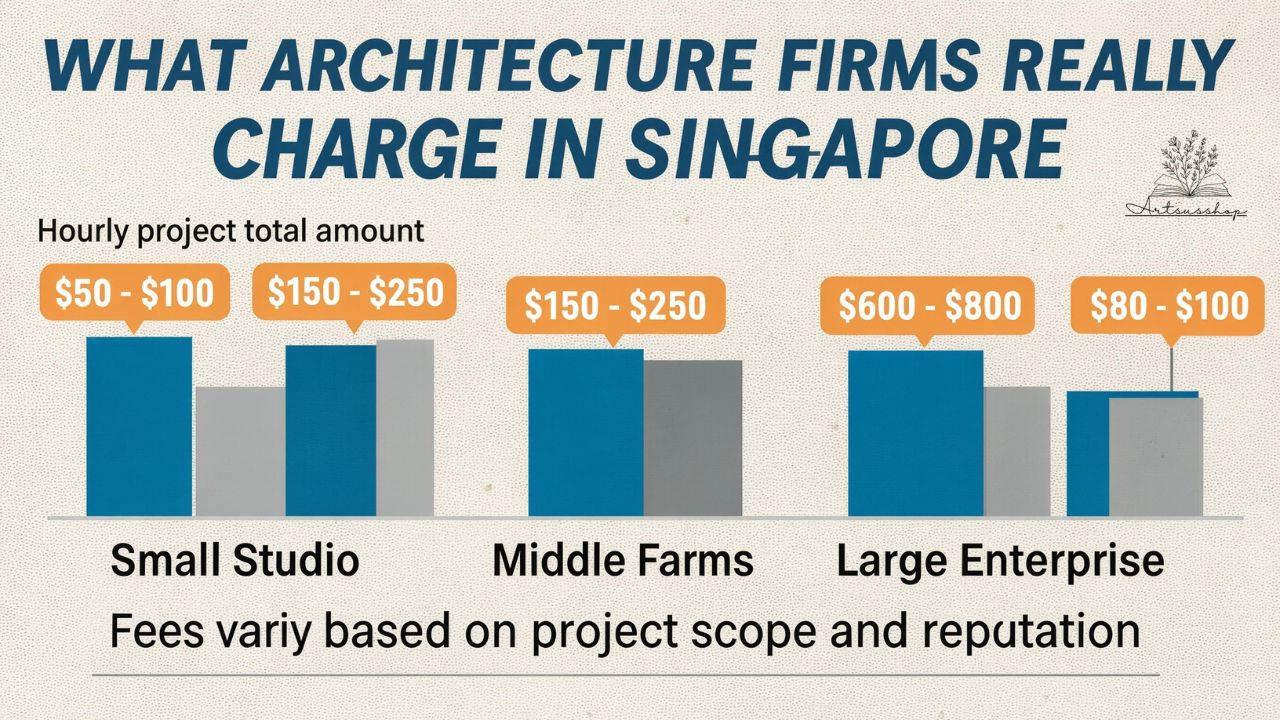
For quick consultations, feasibility studies, or advisory work, many architectural firms in Singapore charge hourly rates:
- Junior architects/drafters: $80-$150/hour
- Senior architects: $150-$280/hour
- Principal architects/directors: $280-$450/hour
This model works well for pre-design services like site analysis or planning consultations, but it’s risky for full projects because costs can spiral quickly without careful scope management.
The Hidden Variables That Inflate (Or Reduce) Architecture Fees
Now here’s where it gets interesting.
Two firms can quote the same percentage—say, 10% of construction cost—but deliver wildly different value. That’s because architectural services aren’t standardized. What’s included in one firm’s fee might be an “extra” at another.
Let me break down the five critical variables that impact what you actually pay.
Variable #1: Scope of Basic Services
The Singapore Institute of Architects (SIA) defines “basic services” as design development through construction administration. But interpretations vary.
Some firms include:
- Unlimited design revisions during concept phase
- Full 3D visualization and physical models
- Weekly site inspections during construction
- Coordination with interior designers and landscape architects
Others limit you to:
- Three design iterations only
- Basic 2D drawings with minimal 3D views
- Monthly site visits
- No consultant coordination (you manage that)
The best architecture firm in Singapore will clearly itemize what’s included in basic services versus additional services. If a quote doesn’t break this down, that’s a red flag.
Variable #2: Project Complexity and Site Constraints
Standard landed property on flat terrain? That’s baseline pricing.
But add any of these factors, and expect fees to jump 15-30%:
- Sloping sites requiring extensive cut-and-fill analysis
- Conservation buildings with strict URA guidelines
- Zero-lot-line developments with complex party wall agreements
- Green Mark Platinum certification requirements
- Complex structural systems (cantilevers, large spans, basements)
A firm quoting 8% for a simple build might legitimately quote 11% for a conservation shophouse conversion—and that’s justified by the additional technical work and authority coordination required.
Variable #3: Authority Submission Stages
Here’s something most clients don’t realize: architectural fees scale with submission complexity.
In Singapore, projects typically go through:
- Provisional Permission (PP) stage – Concept approval from URA
- Written Permission (WP) stage – Detailed compliance documentation
- Building Plan (BP) submission – Full construction drawings to BCA
Each stage requires progressively more detailed drawings and engineering coordination. Firms typically structure payments around these milestones:
- 10-15% upon signing (inception and feasibility)
- 20-25% upon PP submission
- 30-35% upon WP approval
- 20-25% upon BP submission
- 10-15% during construction administration
If your project requires additional submissions—like a second PP for major revisions, or special approvals for heritage sites—those trigger extra fees. Always clarify upfront whether the quote covers “one submission per stage” or unlimited resubmissions.
Variable #4: Consultant Coordination
Architecture is just one piece of the puzzle. You also need:
- Structural engineers
- Mechanical & electrical (M&E) engineers
- Quantity surveyors
- Landscape architects
- Interior designers
Some large architectural practices offer “one-stop” packages where they coordinate all consultants and include it in their fee. Others charge architectural fees only, and you separately engage (and pay) each consultant.
This is critical to understand when comparing quotes. A firm charging 12% all-in might be cheaper than a firm charging 8% architecture-only if you factor in the $80,000-$150,000 you’ll spend on separate consultants.
Variable #5: Firm Reputation and Portfolio
Let’s be real: brand premium exists in architecture.
An award-winning architecture firm with celebrity principal architects charge 20-40% more than lesser-known practices—even for objectively similar projects. You’re paying for their design reputation, their authority relationships, and their ability to attract high-quality contractors through competitive bidding.
Is it worth it? That depends on your priorities. If you’re building a landmark property where design excellence matters more than budget, the premium makes sense. If you’re developing a rental investment property focused on ROI, probably not.
Real-World Fee Examples from 2026 Singapore Projects
Theory is nice. But let’s look at actual numbers.
Example 1: Standard Landed Property (Terrace House Rebuild)
- Construction budget: $1.8 million
- Architectural fee: 9% = $162,000
- Scope: Full basic services including PP, WP, BP submissions, and construction administration
- Consultant coordination: Client manages separately
- Site inspections: Bi-weekly during construction
Example 2: High-End Bungalow with Custom Features
- Construction budget: $4.5 million
- Architectural fee: 11.5% = $517,500
- Scope: Unlimited design revisions, weekly site visits, 3D renderings, physical model, Green Mark Gold coordination
- Consultant coordination: Included in architectural fee
- Special services: Furniture design and custom metalwork detailing
Example 3: Commercial Office Fit-Out
- Project size: 3,200 square meters GFA
- Fixed fee: $120 per sqm = $384,000
- Scope: Space planning, authority submissions, tender drawings, construction administration
- Consultant coordination: M&E and fire protection engineers included
- Timeline: 6-month design and approval phase
Example 4: Mixed-Use Development (Boutique Retail + Apartments)
- Construction budget: $18 million
- Architectural fee: 7% = $1,260,000 (lower percentage due to project scale)
- Scope: Full architectural services plus BIM modeling and contractor coordination
- Payment structure: Milestone-based over 24 months
- Additional services: Developer paid extra $180,000 for alternative scheme studies during pre-design
Notice how percentages drop as project size increases? That’s economies of scale at work.
The Costs Nobody Tells You About (But You’ll Definitely Pay)
Now let’s talk about the expenses that blindside clients.
Resubmission Fees
If URA or BCA rejects your submission due to non-compliance, resubmission often costs $8,000-$25,000 depending on the extent of required changes. Some firms include one free resubmission in their base fee; others charge for every revision. Always clarify this upfront.
Variation Orders
Change your mind mid-project? Want to add a basement gym that wasn’t in the original scope? Expect variation orders charged at $150-$300 per hour for additional design work. On major scope changes, firms might renegotiate to a higher percentage of the revised construction budget.
Extended Construction Administration
Most architectural contracts assume a construction duration of 12-18 months for residential architecture Singapore projects. If your contractor runs late (and they often do), extended site supervision can cost $3,000-$8,000 per additional month.
Specialist Consultants
Certain projects require niche expertise not covered in standard architectural fees:
- Heritage conservation consultants: $15,000-$40,000
- Acoustic engineers (for recording studios, home theaters): $10,000-$25,000
- Lighting designers (for high-end residential): $20,000-$60,000
- Façade engineers (for complex curtain walls): $40,000-$120,000
These add up fast. Budget an extra 3-5% of construction cost for specialist consultants if your project has unique requirements.
How to Actually Compare Architectural Quotes (And Spot Red Flags)
You’ve got three proposals on your desk. Now what?
Use this checklist to compare apples to apples:
Normalize the scope: Create a spreadsheet listing every deliverable (number of design iterations, 3D renders, site visits, submissions included). Check which firm covers what.
Calculate total project cost: Add architectural fees + estimated consultant fees + authority submission fees + contingency for variations. The firm with the lowest architectural fee might have the highest total cost.
Check payment milestones: Be wary of firms demanding 40%+ upfront. Standard practice is 10-15% upon signing. Front-loaded payment schedules put you at risk if the relationship sours.
Look for exclusions: Read the fine print. Are site measurements included? What about as-built drawings after construction? Topographical surveys? These “extras” can add $15,000-$30,000.
Verify insurance coverage: All licensed architectural firms in Singapore must carry professional indemnity insurance. Ask for proof of coverage—it protects you if design errors cause construction defects.
And here’s a pro move: Ask for a detailed fee breakdown by project phase. If a firm won’t provide this transparency, walk away. You’re about to spend hundreds of thousands of dollars—you deserve to know exactly where it’s going.
The Bottom Line on Architecture Fees in Singapore
Here’s what you need to remember.
Architecture fees in Singapore aren’t random—they’re driven by project complexity, scope of services, firm reputation, and how much risk the architect is absorbing. In 2026, expect to pay 8-12% of construction cost for residential projects and $150-$300 per square meter for commercial work.
But the percentage is just the starting point.
The firms that provide the best value clearly itemize their services, include consultant coordination, and offer transparent pricing with no hidden gotchas. They don’t always have the lowest fees—but they give you certainty, which is worth paying for.
So when you’re evaluating quotes, don’t obsess over shaving 1% off the architectural fee. Focus on total project cost, scope clarity, and whether the firm’s expertise matches your project’s demands.
Because the cheapest architect often becomes the most expensive mistake.