There’s something quietly powerful about a hand-painted clay pot or a stitched textile made by someone who never studied in an art school — someone who learned by watching, by doing, by inheriting. That’s the heart of folk art.
So, what is folk art, exactly? The simplest answer: it’s art made by ordinary people within a community, using techniques and visual languages passed down across generations. But that definition barely scratches the surface.
Folk art sits outside the “fine art” world of galleries and academies. It isn’t made to impress critics. It’s made to mark a wedding, bless a harvest, decorate a doorway, or tell a story that a community has carried for hundreds of years. It’s functional, symbolic, and deeply human.
The folk art definition most scholars agree on includes three core traits:
- Community origin — rooted in a specific cultural or regional group
- Oral and visual transmission — skills and designs learned informally, not through formal institutions
- Utilitarian purpose — often made for everyday use, rituals, or celebrations
This distinguishes folk arts from fine art (which values individual genius) and from commercial craft (which prioritizes market demand). Folk art exists at the intersection of identity, memory, and making.
Folk Art Painting: Where Color Carries Memory
Of all the forms folk arts take — weaving, pottery, sculpture, embroidery — folk art painting may be the most immediately recognizable. And the most emotionally direct.
Folk art painting doesn’t follow the rules of perspective or anatomical precision. Figures are often flat, proportions are symbolic rather than realistic, and colors are chosen for meaning, not mimicry. A child painted large in a scene might simply mean the child is important, not that they’re physically close to the viewer.
What makes folk art painting so compelling to modern audiences — and to interior designers, collectors, and anthropologists alike — is exactly this: it operates on its own visual logic. That logic is coherent, intentional, and often ancient.
Some of the most recognized folk art painting traditions in the world include:
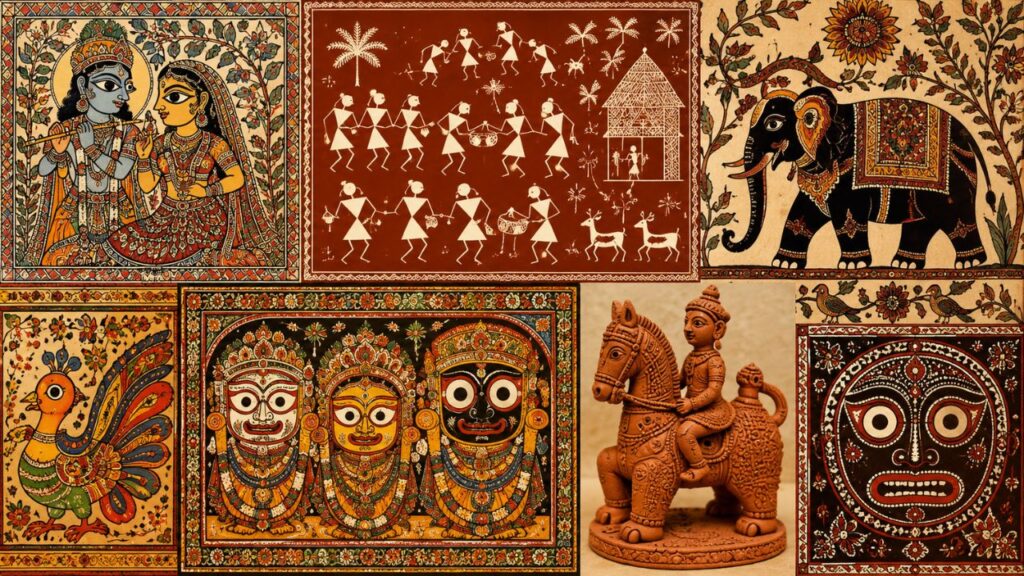
- Madhubani painting (Bihar, India) — intricate geometric patterns with mythological themes
- Warli painting (Maharashtra, India) — white geometric figures on mud-colored backgrounds
- Pennsylvania Dutch hex signs (USA) — circular painted symbols on barns for protection and luck
- Tole painting (Europe and Americas) — decorative painting on metal objects with floral motifs
- Mithila painting — a broader category encompassing several northeastern Indian painting traditions
Each of these is more than decoration. Each one is a visual vocabulary — a way of speaking about the world without words.
Indian Folk Art: A Continent of Creative Traditions
No country on earth has a richer or more varied heritage of Indian folk art than India. With over 29 states and hundreds of distinct cultural communities, Indian folk art isn’t a single tradition — it’s a living ecosystem of dozens of distinct styles, materials, and meanings.
Indian folk art has survived colonial disruption, industrialization, and urbanization because it’s woven into the fabric of daily life and ceremony. It appears on the walls of homes at festivals, on textiles worn at weddings, on the floors of kitchens drawn fresh each morning.
Here are some of the most significant Indian folk art traditions:
Madhubani / Mithila Painting (Bihar)
Originating in the Mithila region of Bihar, this folk art painting tradition was historically practiced by women on the walls of their homes during festivals, weddings, and religious occasions. The paintings depict deities, mythological narratives, and natural imagery — fish, lotus flowers, the sun and moon — using natural dyes and pigments.
Madhubani received global recognition when it was applied to a series of Indian Railways train cars in the 1980s, bringing an ancient folk art tradition to millions of new viewers.
Warli Painting (Maharashtra)
One of the oldest known folk art traditions in India, Warli painting uses basic geometric shapes — circles, triangles, squares — to depict scenes of daily village life: farming, dancing, hunting, marriage ceremonies. The style is instantly recognizable: white paint on a dark brown or red mud background.
Warli art gained commercial attention in the 1970s when artist Jivya Soma Mashe began working with urban galleries, sparking a debate that runs through folk arts globally — how do you commercialize tradition without hollowing it out?
Pattachitra (Odisha and West Bengal)
Pattachitra means “cloth picture” in Sanskrit. This intricate folk art painting tradition features detailed scenes from Hindu mythology, particularly stories of Lord Jagannath, Lord Vishnu, and the Mahabharata. Artists in Raghurajpur village in Odisha have practiced this tradition for generations.
Gond Art (Madhya Pradesh)
The Gond tribal community of central India creates bold, patterned paintings that animate animals, trees, and natural spirits with dense fields of dots and lines. Gond folk art has attracted significant collector attention globally.
Phulkari Embroidery (Punjab)
Not all Indian folk art is painted. Phulkari — meaning “flower work” — is an embroidery tradition from Punjab in which women stitch elaborate floral and geometric patterns onto fabric using silk thread. Traditionally created over years for a daughter’s trousseau, Phulkari is among the most celebrated folk arts of northern India.
Kalamkari (Andhra Pradesh and Telangana)
Kalamkari, literally “pen work,” is a hand-painted or block-printed textile folk art from Andhra Pradesh. Using natural dyes and a tamarind pen, artists depict scenes from Hindu epics like the Ramayana and Mahabharata across fabric that can run several meters long.
Folk Art Examples From Around the World
Folk art isn’t uniquely South Asian, of course. It’s a human universal — every culture that has ever existed has made art this way. Here are folk art examples from across the globe that illustrate the breadth of this tradition:
1. Frida Kahlo’s Retablo-Inspired Paintings (Mexico)
While Frida Kahlo is now a canonical fine art figure, her work drew heavily from the Mexican folk art tradition of retablos — small devotional paintings on tin that thank saints for miracles. Her flattened figures, symbolic animals, and vivid color palettes are deeply rooted in folk art aesthetics.
2. Appalachian Quilts (United States)
Among the most celebrated folk art examples in American history, Appalachian quilts — particularly those from Gee’s Bend, Alabama — combine functional textile-making with bold, improvisational geometric design. Scholars now regard these quilts as among the most significant art objects in American history.
3. Amate Bark Painting (Mexico)
One of the oldest folk art examples in the Americas, Amate painting uses handmade bark paper to depict ceremonial and natural scenes. Originally produced by the Nahua and Otomi peoples, it remains a living tradition practiced in the state of Guerrero.
4. Norwegian Rosemaling
Rosemaling is a decorative folk art painting tradition from Norway featuring flowing, scrolling floral and acanthus patterns. Brought to the United States by Norwegian immigrants, it became a significant part of Midwestern American cultural heritage.
5. Russian Matryoshka and Khokhloma
Russian folk art traditions include the lacquered wooden nesting dolls (matryoshka) and the distinctive Khokhloma style of painting — black, red, and gold floral patterns on wooden kitchenware.
6. Aboriginal Dot Painting (Australia)
Aboriginal Australians have one of the oldest continuous artistic traditions on earth. Dot painting, which became widely known in the 1970s through the Papunya Tula movement, translates sacred sand and body-painting traditions onto canvas — a folk art form with deep ceremonial meaning.
7. Oaxacan Woodcarving (Mexico)
The brightly painted animal figures — known as alebrijes — produced by artisans in the Oaxacan villages of Arrazola and San Martín Tilcajete represent a relatively recent (mid-20th century) but now deeply embedded folk art tradition.
These folk art examples share something essential: they emerged from communities rather than academies, they carry cultural meaning, and they endure because the communities that created them continue to value them.
The Folk Art Definition: A Deeper Look
The folk art definition has been debated by scholars, museum curators, and cultural preservationists for over a century. And the debate matters — how you define folk art determines what gets preserved, funded, and recognized.
The folkart meaning has evolved considerably:
Early 19th century: European Romantic scholars coined the concept of “folk” (German: Volk) to describe peasant communities with authentic, unspoiled cultural traditions — in contrast to “decadent” urban culture. Folk arts were romanticized as primitive purity.
Early 20th century: American art institutions began “discovering” self-taught artists and rural craft traditions. The term folk art was applied broadly to anything outside the fine art academy — creating definitional confusion that persists.
Post-1970s: Scholars distinguished between folk art (traditional, community-based), outsider art (individual self-taught artists disconnected from tradition), and naive art (trained artists who adopt simplified styles). These are related but distinct categories.
Contemporary definition: Most anthropologists and folklorists today define folk art through the lens of community transmission and cultural function — not style, medium, or aesthetic quality.
The folk art definition also raises questions of authenticity. When a Warli artist sells paintings to a Mumbai gallery, or when a Madhubani motif appears on a luxury sari brand’s label, is that still folk art? The folkart meaning becomes contested at the border between tradition and commerce.
Folk Art vs. Fine Art vs. Craft: Understanding the Differences
| Feature | Folk Art | Fine Art | Craft |
|---|---|---|---|
| Maker | Community artisans | Individual artists | Skilled craftspeople |
| Training | Informal, generational | Formal, academic | Technical apprenticeship |
| Purpose | Functional, ritual, communal | Aesthetic, expressive | Decorative, functional |
| Audience | Own community | Art world, collectors | General consumer |
| Innovation | Evolutionary, conservative | Individual, experimental | Technical refinement |
| Examples | Madhubani, quilts, hex signs | Oil paintings, sculpture | Furniture, ceramics |
Understanding these distinctions helps clarify the folk art definition and reveals why folk arts occupy a unique cultural space that neither fine art nor craft fully covers.
Why Folk Art Matters Today
Folk art is not a relic. It’s an active, evolving practice — and its importance is arguably greater now than it was a century ago.
Cultural identity and resistance: For marginalized communities — Indigenous peoples, caste-oppressed artisan communities, immigrant diaspora groups — folk art is a form of cultural assertion. When the Dalits of Bihar practice Madhubani painting, they aren’t just making beautiful objects. They’re claiming ownership of their own story.
Sustainable livelihood: Organizations like the Crafts Council of India and the Indian government’s development body, the Office of the Development Commissioner for Handicrafts, have worked to ensure that Indian folk art practitioners can earn sustainable incomes from their traditions. The global market for authentic folk arts is significant and growing.
Mental health and community cohesion: Research in community psychology has shown that participation in traditional folk arts — communal weaving, shared painting practices, collective storytelling — builds social cohesion and individual wellbeing. The act of making together is itself meaningful.
Ecological knowledge: Many folk art traditions encode deep ecological knowledge. Warli painting depicts farming cycles. Madhubani painting maps the agricultural calendar through imagery. Folk art painting traditions in Rajasthan often encode knowledge about local water sources and seasonal patterns.
How Folk Art Is Preserved and Promoted
Protecting folk arts in the 21st century requires active, thoughtful intervention. Several organizations and strategies are doing this work:
UNESCO’s Intangible Cultural Heritage List has recognized dozens of folk art traditions globally, including Madhubani painting and the art of Armenian cross-stones (Khachkars). This recognition doesn’t prevent change, but it raises visibility and sometimes enables funding.
The Crafts Council of India connects urban markets with rural artisans, helping folk art practitioners commercialize their work without losing the cultural context that makes it meaningful.
Geographical Indication (GI) Tags in India protect Indian folk art traditions from unauthorized reproduction. Madhubani painting, Phulkari embroidery, and Kalamkari have all received GI tags — a form of intellectual property protection for community-held traditions.
Folk art museums around the world — including the American Folk Art Museum in New York, the Crafts Museum in New Delhi, and the Ethnological Museum in Berlin — preserve and contextualize these traditions for broader audiences.
Getting Started: Appreciating and Collecting Folk Art
Whether you’re a first-time buyer, a student of art history, or simply someone who finds folk art painting more compelling than gallery-world abstraction, here’s how to engage with folk arts meaningfully:
Visit source communities when possible. The most authentic experience of folk art happens in context — at a festival in Raghurajpur where Pattachitra artists work, at a craft fair in Kutch where embroiderers demonstrate their techniques.
Buy directly from artisans. Platforms like Gaatha, Craftsvilla, and the Indian government’s GoCoop connect buyers directly with Indian folk art makers, ensuring artisans receive fair compensation.
Learn the stories behind the objects. A Madhubani painting of fish isn’t just decorative — fish are auspicious symbols in Mithila culture, associated with fertility and abundance. Understanding the folkart meaning behind an object deepens your relationship with it.
Support GI-tagged traditions. When you buy a GI-tagged folk art product, you’re supporting a system designed to protect the economic rights of traditional artisan communities.
FAQ: Common Questions About Folk Art
Q: What is the simple folk art definition?
Folk art is traditional art created within a specific community using techniques and visual styles passed down across generations, typically for functional, ritual, or celebratory purposes rather than purely aesthetic ones.
Q: How is folk art different from fine art?
Fine art is typically created by individually trained artists for aesthetic appreciation and gallery display. Folk art is made within communities, transmitted informally, and often serves practical or ceremonial functions alongside its decorative role.
Q: What are the most well-known Indian folk art traditions?
Among the most recognized forms of Indian folk art are Madhubani painting, Warli painting, Pattachitra, Gond art, Kalamkari, Phulkari embroidery, and Tanjore painting. Each originates in a specific region and carries distinct visual and cultural characteristics.
Q: Is folk art the same as tribal art?
Not exactly. Tribal art refers specifically to art made by indigenous or tribal communities, often with strong ritual or spiritual functions. Folk art is a broader category that includes rural, non-tribal communities as well. There is overlap, but they aren’t identical.
Q: Can folk art be modern?
Absolutely. Folk art traditions are living — they evolve, absorb new influences, and respond to contemporary contexts. A Warli artist painting on canvas for sale in a gallery is still engaged in folk art, even if the medium and audience have changed.
Q: What materials are typically used in folk art painting?
Traditional folk art painting uses locally available materials: natural pigments from plants and minerals, handmade paper, cotton and silk textiles, clay-coated surfaces, and animal-hair brushes. Contemporary practitioners sometimes incorporate acrylic paints and commercial canvas while maintaining traditional motifs and compositional logic.
Q: Why is Indian folk art important?
Indian folk art is important for several reasons: it preserves cultural memory, provides sustainable livelihoods for artisan communities, encodes ecological and social knowledge, and represents India’s extraordinary regional diversity. It also increasingly attracts international collectors and designers, generating significant export revenue.
Q: What does folkart meaning refer to in academic contexts?
In academic contexts, folkart meaning refers to the cultural, symbolic, and social significance that folk art objects carry within their originating communities — as distinct from their aesthetic or market value. A Gond painting’s meaning includes its relationship to the natural world, tribal identity, and spiritual belief systems.